












































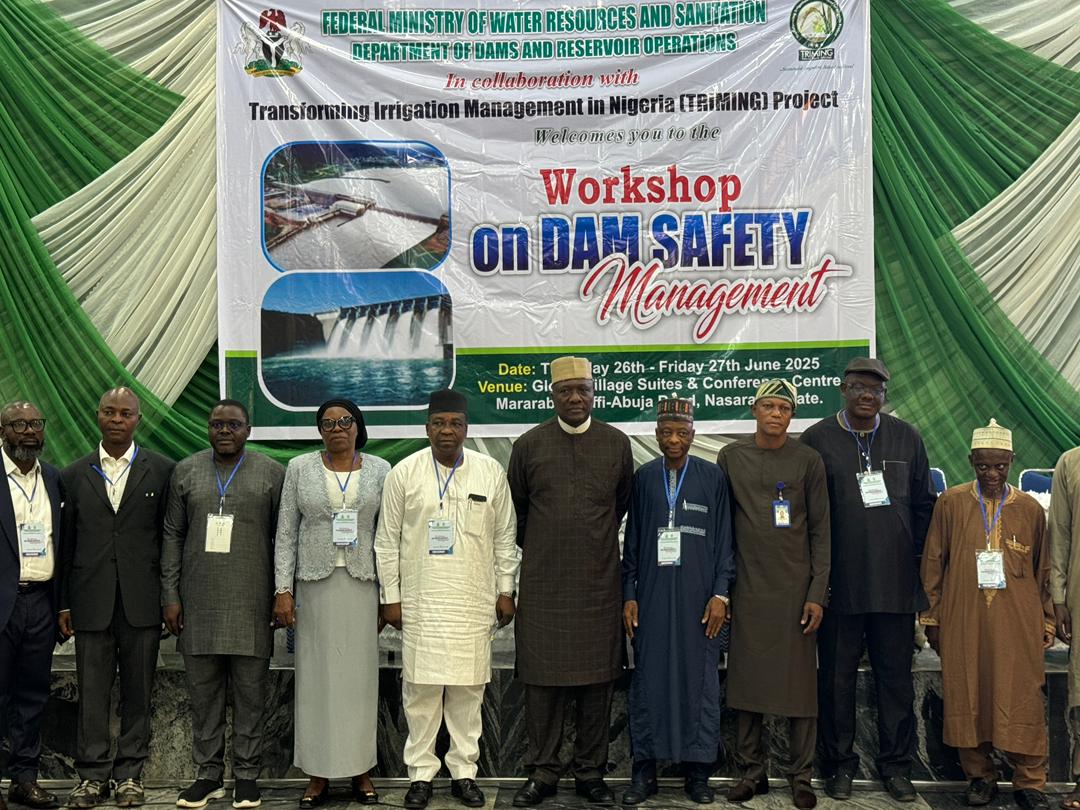
To protect strategic infrastructure essential for national development, the Federal Government has expressed commitment to ensuring the safety and resilience of Nigeria’s dams.
Permanent Secretary, Federal Ministry of Water Resources and Sanitation, Mr Richard Pheelangwah, made this known at the opening of a two-day workshop on dam safety in Abuja.
Pheelangwah, who was represented by the Director, Reforms Coordination in the ministry, Mr Moses Jo-Madugu said the government remained resolute in strengthening dam infrastructure to support irrigation, potable water supply, hydropower, and flood management.
“Dams are critical national assets, but they also present significant risks if not properly managed. Ensuring their safety is vital for protecting lives, livelihoods and property, and is also central to achieving the objectives of the SPIN Project,” he said.
He said the government remained resolute in strengthening dam infrastructure to support irrigation, potable water supply, hydropower, and flood management.
He noted that the ministry was working closely with development partners to incorporate best practices in dam management, including early warning systems, emergency preparedness, and climate adaptation strategies.
According to him, the workshop provides a platform for knowledge sharing, technical learning, and collaboration among key actors in dam operations across the country.
He reaffirmed the ministry’s commitment to ensuring that dams nationwide operate in accordance with the highest safety standards, adding that all owners must be guided by established safety frameworks.
Pheelangwah who commended the World Bank, the TRIMING Project Management Team, and the organising committee for their support in convening the workshop encouraged participants to engage actively and apply the lessons learned to improve dam safety management at all levels.
On his part, the Permanent Secretary Ministry of Power,
Mahmuda Mamman emphasized that Dams are strategic national assets, playing vital roles in water supply, flood control, irrigation, and critically, in harnessing hydropower resources to boost electricity generation across Nigeria.
“Their safe and efficient operation is essential to national development and must remain a top priority in our infrastructure and energy agendas” he noted.
Mamman expressed happiness to be a part of the Sustainable Power and Irrigation for Nigeria (SPIN) Project stating that under this project, the Ministry is spearheading the implementation of the Hydropower Component in collaboration with the Federal Ministry of Water Resources and other partners in preparing a national hydropower development master plan which will lay the foundation for private sector participation through Public-Private Partnerships (PPP) in the delivery of transformative hydropower projects.
In his remarks, Acting Director-General of the National Water Resources Institute (NWRI), Kaduna, Dr Martins Eduvie called for stronger institutional mechanisms to safeguard Nigeria’s more than 420 registered dams.
Eduvie stressed that although many dams serve crucial purposes such as water supply, irrigation, flood control, and energy generation, their management is sometimes underplayed.
Earlier, the Director of Dams and Reservoir Operations in the ministry, Mr Ali Dallah, said the safety of Nigeria’s dams must not be taken lightly, considering the role they play in supporting food production, water access, electricity, and flood control.
The workshop is part of the stakeholder engagement activities under the Sustainable Power and Irrigation for Nigeria (SPIN) Project, which is supported by the World Bank.