













































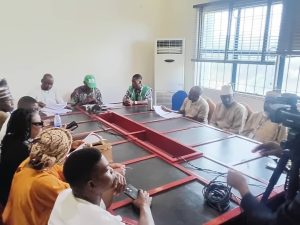
The Chairman of the Coalition of INEC-accredited domestic observers in the FCT, Professor Isaac Iduma, has released a preliminary report on the February 21, 2026 Area Council elections, describing the exercise as generally peaceful but flawed in key areas.
Professor Iduma who stated this during a news conference in Abuja, explained that the elections were conducted by the Independent National Electoral Commission (INEC) across the six FCT area councils—Abaji, Abuja Municipal Area Council, Bwari, Gwagwalada, Kuje and Kwali—to fill six chairmanship and 62 councillorship seats.

Citing INEC figures, Professor Iduma said over 1.6 million voters were registered, while more than 1.5 million collected their Permanent Voter Cards.
He added that 637 candidates from 17 political parties contested the elections in 2,818 polling units.
Professor Iduma explained that the Coalition deployed 500 observers and operated a situation room to receive real-time reports.
According to him, restriction of movement was largely complied with, and election materials arrived early in many polling units, enabling voting to commence on time in several areas.

However, Professor Iduma expressed concern over the sudden splitting and relocation of some polling units without adequate voter education.
He noted that this created confusion, as some voters struggled to locate their designated polling units.
On security, he said personnel from various agencies were present across polling units. While he commended the level of coordination among security agencies, he reported incidents of intimidation, alleged misconduct by some personnel, and the presence of armed vigilantes in certain areas.
Professor Iduma further disclosed that there were reports of violence and harassment in some locations, including alleged assaults on voters and party agents.
He also noted that some INEC-accredited observers were reportedly detained during the exercise.
On vote buying, Professor Iduma stated that the practice was widespread in parts of Bwari, Dutse Alhaji, Mpape and AMAC, with allegations that voters were induced with cash payments.
He also observed that voter turnout was generally low, particularly in urban communities.
He cited an example in Kuje where only 69 out of 770 registered voters cast their ballots in one polling unit.
Despite the shortcomings, Iduma acknowledged INEC’s effective distribution of sensitive and non-sensitive materials, as well as its administrative coordination.
Professor Iduma maintained that while the election was largely peaceful, it fell below expected standards due to voter inducement, intimidation and operational lapses.
He called for electoral reforms, stricter enforcement against vote buying, improved voter education and stronger protection of citizens’ rights in future elections.