














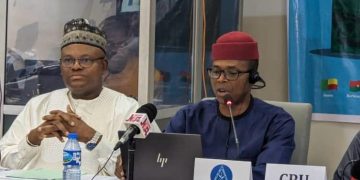































The Nigerian Education Loan Fund has yet to begin recovering loans from beneficiaries despite recording a monthly upkeep bill of about ₦16bn, its Managing Director, Akintunde Sawyerr, has said.
Sawyerr, who spoke in an interview with ARISE NEWS on Monday, said the Federal Government was exploring alternative ways of funding the student loan scheme to ensure its sustainability.
He said the scheme, which is more than two years old, had yet to record loan recoveries, raising questions about how its growing financial obligations would be sustained.
“I think the President, in his magnanimity, is looking for ingenious ways to be able to continue to fund education. It’s a loan scheme. It’s two years plus old.
“We’re not getting any recoveries of the loans as of today. But how do you keep it going? We have a bill every month, as of today, of about 16 billion in upkeep alone. How do you maintain that? How do you keep that going?
“I think what the President is doing is looking for different ways of re-channeling, redirecting funds to a cause that is indeed very worthy from capital that’s probably sitting idle,” Sawyerr said.
Proceeds of crime should benefit young Nigerians, Sawyerr says
Sawyerr said the Federal Government was considering the use of recovered proceeds of crime and other funds to support education, arguing that such resources could be redirected towards young Nigerians.
“Finally, you talked about corridors—sharing corridors of proceeds of crime. Again, it is those corridors, those proceeds of crime, that in many ways have led to the neglect in education. We must be able to find the link to make our country better,” he said.
Clarifying the government’s position, Sawyerr said the proposal was not intended to encourage plea bargaining or shield individuals accused of misappropriating public funds.
“I don’t believe that what is intended here is to approach those who have… The President did not say, ‘Go and plea bargain or set up a plea bargain arrangement with those who have misappropriated Nigeria’s funds and then give it to NELFUND.’ He didn’t say that. The issues of misappropriated funds and proceeds of crime are entirely separate—completely separate to NELFUND,” Sawyerr said.
He said the proposal was aimed at redirecting recovered funds towards young Nigerians affected by the diversion of public resources.
“What has happened is that people have been found wanting in terms of fund acquisition, looting—as is the word that is commonly used—when those cases are settled, and the liquid elements of that are warehoused somewhere, the President is asking a very important question: ‘Why can’t we use it for the victims who suffered for some of these crimes?’” he said.
“And the victims tend to be the young; they tend to be those who want to get an education. So, he’s looking—he’s very focused, President Tinubu is very focused on trying to help those at the bottom of the ladder who never have really benefited from anything, but in fact, have suffered from the misappropriation of Nigeria’s wealth. I think this is pretty interesting, what he’s trying to do, and I’m in full support of it. The devil’s in the detail, of course, but I’m in full support of it,” Sawyerr added.
NELFUND cannot rely on proceeds of crime long-term
On the long-term sustainability of the scheme, Sawyerr said NELFUND could not rely on proceeds of crime as a permanent funding source.
He said the law establishing the agency allowed it to seek charitable donations, attract investments and invest in ventures capable of generating returns.
“Moving on to the question that was asked earlier about long-term sustainability: the law that set up NELFUND allows us to go out and seek charitable donations, it allows those who want to invest in NELFUND to invest, and it allows NELFUND itself to invest in elements that are going to bring a return and income. What we’re seeing, I believe, today is short-term interventions,” Sawyerr said.
“We’re hoping the proceeds of crime in this country will reduce as the anti-corruption drive goes on in other parts of government, so we can’t possibly rely on proceeds of crime in the long term. But if you look at the law that set this up, it does allow us to source funds from other places,” he added.
Sawyerr said NELFUND was already attracting interest from the private sector because of its potential impact on employment and Nigeria’s broader socio-economic development.
“And I can tell you today that there’s a lot of interest already from the private sector—from those who recognize how this can impact the economy, how this can impact employment, how this can impact crime, how this can impact banditry and insurgency.
“Those who recognize the benefit to the socio-political growth of Nigeria know that this must be sustainable. It’s about political will from the top, and it’s about participation from the people in the country.
“We all need to keep ourselves safe in this country by ensuring that we can fund this program adequately in the long term,” Sawyerr said.