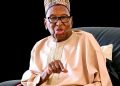









































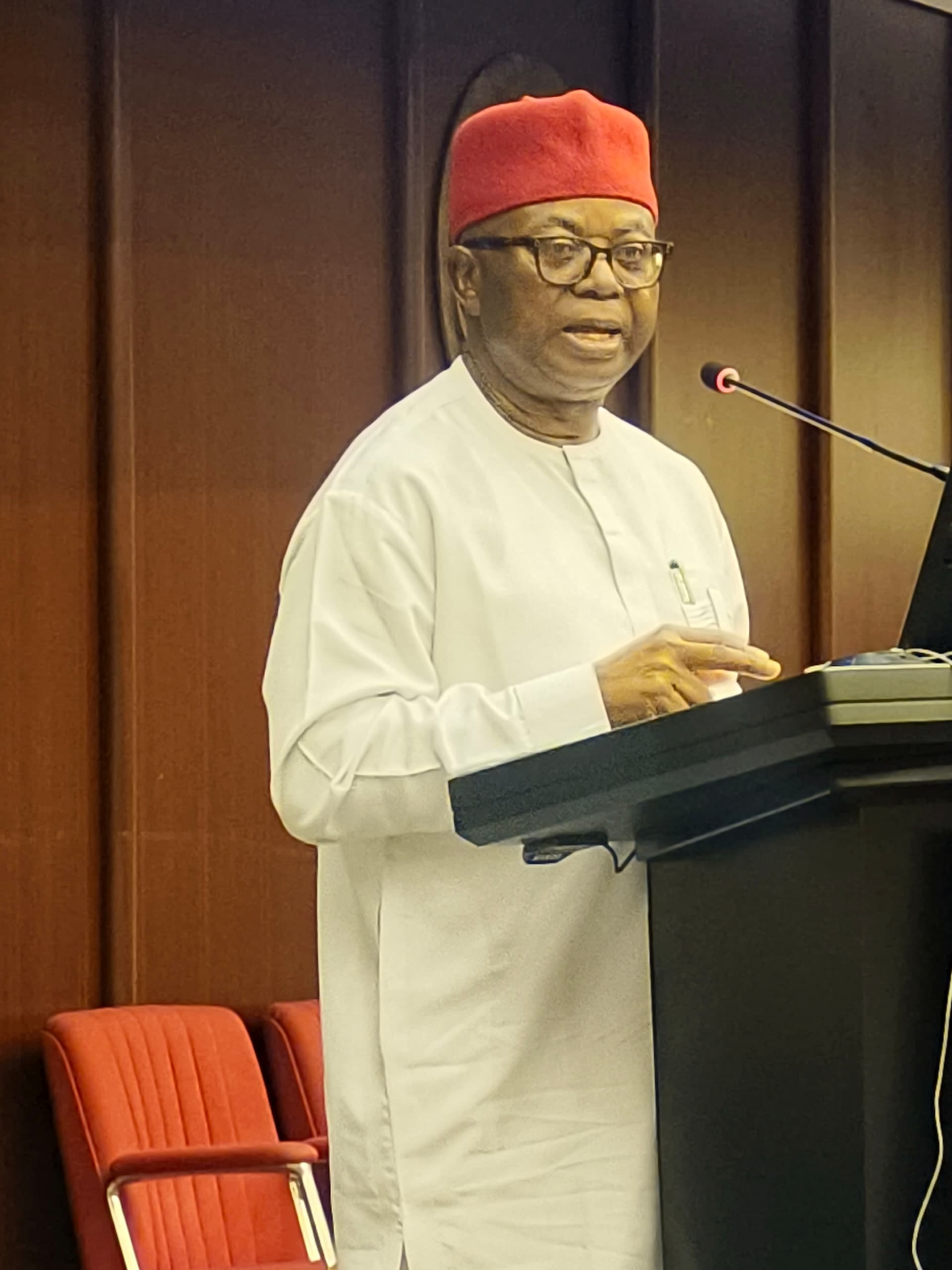
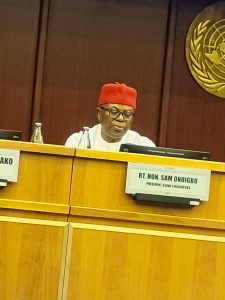
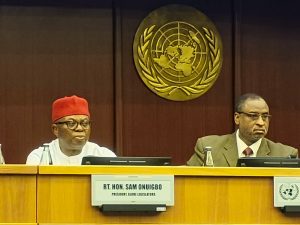
Former member of Representatives and President GLOBE Legislators, Sir Sam Onuigbo, has urged African countries to move from participating in global climate discussions to taking ownership of the rules, institutions, financing and implementation pathways that shape the continent’s climate future.
Onuigbo made the call while presenting a paper at the 14th Conference on Climate Change and Development in Africa, CCDA-XIV, in Addis Ababa, Ethiopia.
He said Africa’s climate future must be built, financed, governed and defended by Africans, rather than depending on external pledges and interventions.
According to him, climate leadership requires Africa to move beyond demanding climate justice to designing and implementing solutions that reflect the continent’s development priorities.
Onuigbo said the real test of climate ambition was no longer the number of pledges made, but the ability to translate such commitments into laws, budgets, projects, accountable institutions and measurable outcomes.
He stressed that Africa’s Nationally Determined Contributions should become practical implementation frameworks, with clear responsibilities, financing arrangements, investment plans and mechanisms for measuring results.
The former lawmaker cited Nigeria’s Climate Change Act 2021 as an example of how climate priorities could be translated into law, institutional coordination and accountability.
He said Africa must also strengthen its role in determining how multilateral climate funds are accessed and disbursed, while ensuring that African institutions are given greater responsibility in financing solutions to African challenges.
Onuigbo further called for the mobilisation of African capital from pension funds, sovereign wealth funds, commercial banks and development finance institutions to support climate and development projects.
He said Africa must also shape global rules on carbon markets and climate-related trade, warning against a situation where the continent supplies raw materials and cheap carbon credits while greater value is created elsewhere.
He maintained that Africa’s energy transition must address energy access, affordability, industrialisation, clean cooking and job creation, particularly given the continent’s huge development needs.
Onuigbo said Africa’s renewable energy, critical minerals, agricultural resources, forests and oceans should be developed into value chains capable of creating jobs, investment and prosperity on the continent.
He stressed that Africa’s climate leadership must ultimately be measured by its impact on farmers, communities, businesses, women, young people and industries.
Onuigbo said the continent must therefore define its own development-compatible climate pathway, build institutions to implement it, mobilise African capital and help shape global climate rules.
“Climate leadership is not simply asking for a better global system. It is building one — with African institutions, African decisions, African capital, and African authority at the centre.”